Semantic Layer for AI
AI Analytics and Automation Can Only Scale with a Unified Semantic Layer and MCP-Enabled Collaboration
The Challenge: The Scale Barrier in Enterprise AI
While AI adoption has exploded, most organizations remain stuck in the "pilot phase" because they lack a governed data foundation. Security and compliance are the primary barriers to scaling,
with 52% of organizations identifying compliance as their top challenge.
Without centralized control, fragmented data sources- each speaking a "different language" - create multiple versions of the truth, leading to AI hallucinations that pose significant strategic and regulatory risks.
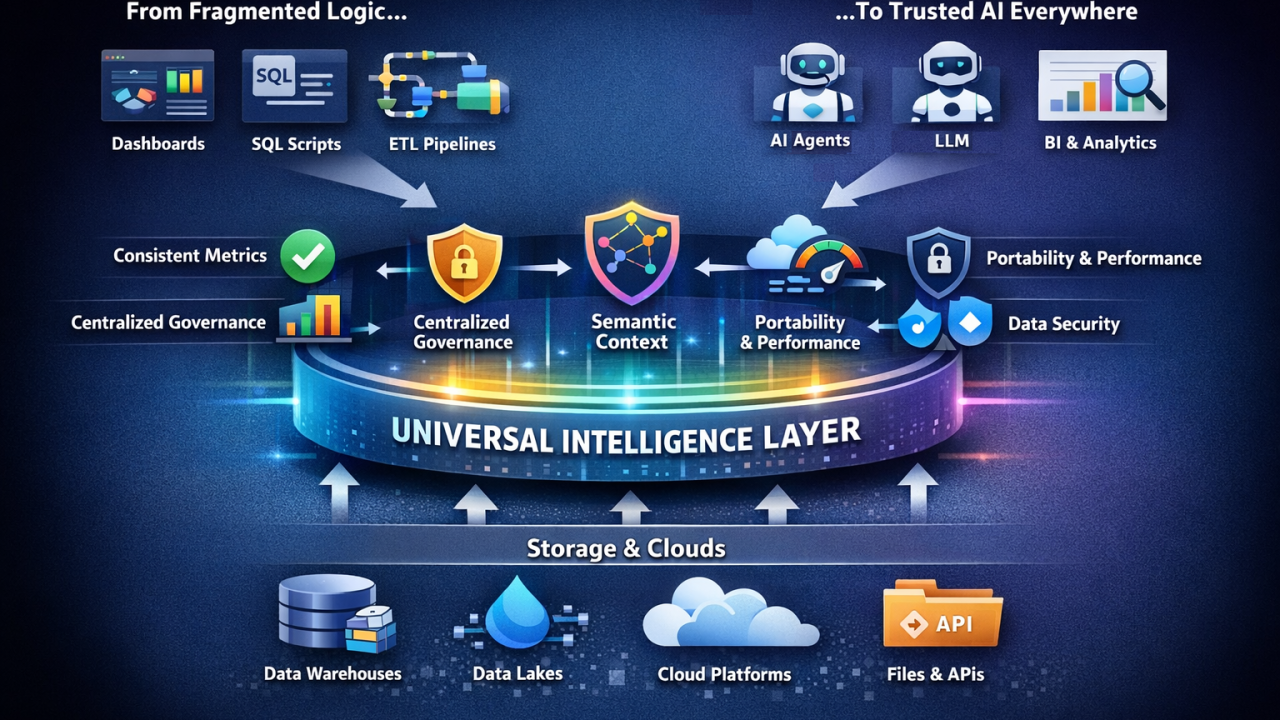
The Foundation: A Universal Semantic Layer
To scale with confidence, enterprises must shift governance from siloed tools to a shared governance fabric.
Strategy Mosaic acts as this universal semantic layer, serving as a central hub that translates complex technical data into standardized, business-friendly terms.
- Declared Once, Applied Everywhere: Governance policies are centralized rather than scattered, ensuring consistent enforcement across BI dashboards, AI agents, and custom applications.
- Fine-Grained Security:
Mosaic provides sophisticated filters at the
row-level
(e.g., by region),
column-level
(e.g., protecting PII), and feature-level (e.g., permissions to query with AI).
- Trusted Source of Truth: By providing a unified view of metrics and KPIs, it ensures that AI agents speak to a governed source of truth, drastically improving accuracy and reducing audit risks.
The Connector: MCP-Enabled Collaboration
Scaling AI requires more than just governed data; it requires a standard way for AI orchestrators to interact with that data.
The Model Context Protocol (MCP) is the open-source "universal adapter" that solves this integration nightmare.
- Eliminating Connector Complexity: Instead of maintaining a "tangled web" of custom connectors for every tool, MCP provides a single, secure protocol for any AI application to communicate with your data ecosystem.
- Context-Aware AI Agents:
Through MCP, AI orchestrators like Gemini or ChatGPT can dynamically connect to Strategy Mosaic, delivering context-aware insights that strictly adhere to the user’s specific access rights.
- Seamless Integration: MCP allows your enterprise orchestrator to route requests to a dedicated MCP server, validating permissions and pulling real-time, authorized data for a consistent user experience.
The Outcome: Scalable Intelligence Without Chaos
By uniting Strategy Mosaic with MCP, organizations can finally move from experimental silos to fully scaled, transformative AI .
- Trust & Explainability: AI decisions become auditable and grounded in business logic, satisfying both boards and regulators.
- Operational Efficiency : Eliminating redundancy and policy drift reduces compute costs and IT bottlenecks, accelerating the delivery of insights.
- Future-Proof Architecture: Decoupling governance from underlying platforms ensures that your AI strategy remains resilient through cloud migrations, mergers, and evolving toolsets.
Governance is not just an IT priority - it is the enterprise foundation for trusted, scalable AI.
_______________________________________
Why Strategy Semantic Layer?
The Strategy Advantage: 30 Years in the Making
Strategy has spent the last 30 years perfecting it as the core of our platform, while the market treats the semantic layer as a new trend.
We provide the essential "Universal Logic" that transforms fragmented data into a governed, high-fidelity source of truth.
By choosing Strategy, you aren't just buying a tool;
you are deploying a
battle-tested foundation
that eliminates AI hallucinations and ensures your business metrics remain consistent, regardless of which AI agent or analytics tool is asking the questions.
There are several Key Dimensions while searching for semantic layers , Strategy answers all:
- Platform Independence & Federation: Don’t let your logic get trapped in a specific warehouse or BI tool.
Your business definitions should survive platform migrations and allow you to query across clouds without moving data. - AI-Powered Modeling: Traditional modeling takes weeks.
The next generation uses AI to reduce cycles from weeks to days through automated relationship discovery and natural-language metric creation. - Semantic Depth & Richness: Basic aggregations won't cut it for complex enterprise needs.
You need a true semantic graph that handles complex hierarchies and time intelligence - this is what allows AI to actually reason about your data. - Open Standards & Universal Access: Your layer must speak every "data language" - SQL, REST, DAX, and MDX.
Insist on alignment with Open Semantic Interchange (OSI) to ensure interoperability across your entire ecosystem. - Active Security & Governance: Security (RLS/CLS) must be defined once and enforced everywhere - from your executive dashboard to your AI agent's prompt - with full version control and audit trails.
- AI Agent Readiness: This is the bridge for generative AI.
By using the Model Context Protocol (MCP), you can provide governed context to AI agents, which has been shown to reduce hallucinations by 22%. - Performance, Scalability & Cost: You need sub-second responses on billions of rows without the "surprise" of consumption-based pricing that punishes growth. Look for hybrid execution and predictable cost models.